

Media Training in a World of AI-Generated Content: The New Rules for Spokespeople
By Justine David

The opening scene: when preparation really mattered
The cameras were rolling, the livestream counter was ticking, and the interview had started exactly as scripted. A senior executive was talking through a new sustainability commitment when the journalist suddenly pivoted:
“Last night, a video circulated claiming your factories are doing the opposite of what you’re saying here. It looks real. Is it?”
Eighteen months ago, that question might have derailed the conversation. However, today, it is increasingly common. In this case, the spokesperson did three things well. They acknowledged awareness of the clip, calmly stated that the footage was AI‑generated and already under review by independent fact‑checkers, and then anchored back to specific, verifiable data about the company’s real‑world performance.
The interview moved on, and the clip that later circulated most widely was not the deepfake — it was the executive’s composed and confident response. That outcome did not happen by accident. It was the result of media training designed for an AI‑saturated, always‑environment.
What’s changed in the media landscape
The fundamentals of a strong media interview — clarity, honesty, empathy and preparation — have not changed. What has changed is the context in which spokespeople operate.
AI-generated content is everywhere. Highly realistic synthetic images, videos and quotes can now be produced and shared in minutes, blurring the line between truth and fiction for audiences.
Journalists are under intense workload pressure. Many are expected to file more stories across more platforms, often with fewer resources and less time to verify everything they see online.
The 30-second clip dominates. A single answer can be clipped, subtitled and shared out of context on social platforms within minutes, reaching far beyond the outlet that did the original interview.
AI tools shape coverage. Reporters and newsrooms increasingly use AI to summarise background information, draft copy and suggest angles — often based on whatever is most visible and recent online.
In this environment, spokespeople are not just answering questions; they are competing with synthetic narratives, compressed attention spans and algorithmic amplification. Media training has to reflect that reality.
The five new rules for preparing today’s spokespeople
1. Know your AI footprint
It is no longer enough to scan headlines and social feeds before an interview. Spokespeople need to understand their AI footprint — how they and their organisations are appearing in machine‑generated content.
That includes:
Checking what popular AI tools currently say about your company, your leaders and your sector
Identifying recurring inaccuracies, outdated narratives or missing context that might influence how journalists frame questions
Anticipating how existing statements, reports or visuals could be misused to create plausible‑sounding fakes
You cannot control everything that is generated about you, but you can prepare spokespeople with a realistic picture of the information environment they are walking into.
2. Prepare for the clip, not just the interview
Traditional media training often focuses on “getting through” the 10‑minute interview. In 2026, the real test is the 10‑ to 30‑second clip that travels on social platforms and internal channels afterwards.
Modern preparation should:
Help spokespeople craft concise, stand‑alone answers that make sense even if they are lifted out of context
Highlight phrases and metaphors that could be misleading or easily misinterpreted if separated from the full answer
Train for multiple formats — broadcast, virtual interviews, podcasts, short‑form social video — so messages stay clear across channels
The goal is not to be robotic; it is to ensure that the most likely clips reflect what the spokesperson actually means.
3. Anchor to three core messages — and mean them
Message discipline has always been part of media training. The difference now is that generic messages are more dangerous than ever. In a world of AI‑assisted content, audiences can smell copy‑and‑paste answers instantly.
Effective spokespeople in 2026:
Work with communications teams to define three core messages that are specific, provable and aligned with real decisions and behaviours
Use tangible examples, numbers or stories that AI tools are unlikely to invent in the same way, signalling authenticity
Are prepared to repeat and reinforce these messages without sounding evasive — because they genuinely believe them
Anchoring to three credible messages gives both journalist and audience something solid to hold on to amid a flood of information.
4. Understand the journalist’s constraints as well as your own
Today’s journalists are working under intense deadline pressures, often juggling multiple beats and formats. Spokespeople who understand this reality can be more helpful — and, as a result, more trusted.
In media training, that means:
Encouraging spokespeople to ask clarifying questions about the outlet’s audience, angle and format before the interview
Preparing supporting materials (data sheets, visuals, timelines) that make it easier for journalists to verify facts quickly
Coaching spokespeople to acknowledge constraints — for example, “I know you only have two minutes; here’s the most important context” — without sounding controlling
This mindset shift frames interviews as a partnership to inform the public, not a one‑sided performance.
5. Practise discomfort, not just the easy questions
Perhaps the biggest shift for media training is the need to practise discomfort deliberately. In a world where misinformation, old quotes or unexpected visuals can surface at any moment, avoiding tough territory is no longer an option.
Modern sessions should include:
Realistic “left‑field” questions based on AI‑generated rumours, historic controversies or hypothetical scenarios
On‑camera drills where spokespeople must correct misinformation calmly, without amplifying it unnecessarily
Practice in saying “I don’t know yet” or “we are still investigating” in ways that are honest but reassuring
The aim is to build emotional muscle memory so that, when a genuinely uncomfortable moment arises, the spokesperson’s instincts are to slow down, stay human and respond constructively.

Contributor insight: what’s changed in the last 18 months
IPREX partners who run media training programmes across multiple regions report a clear acceleration in expectations.
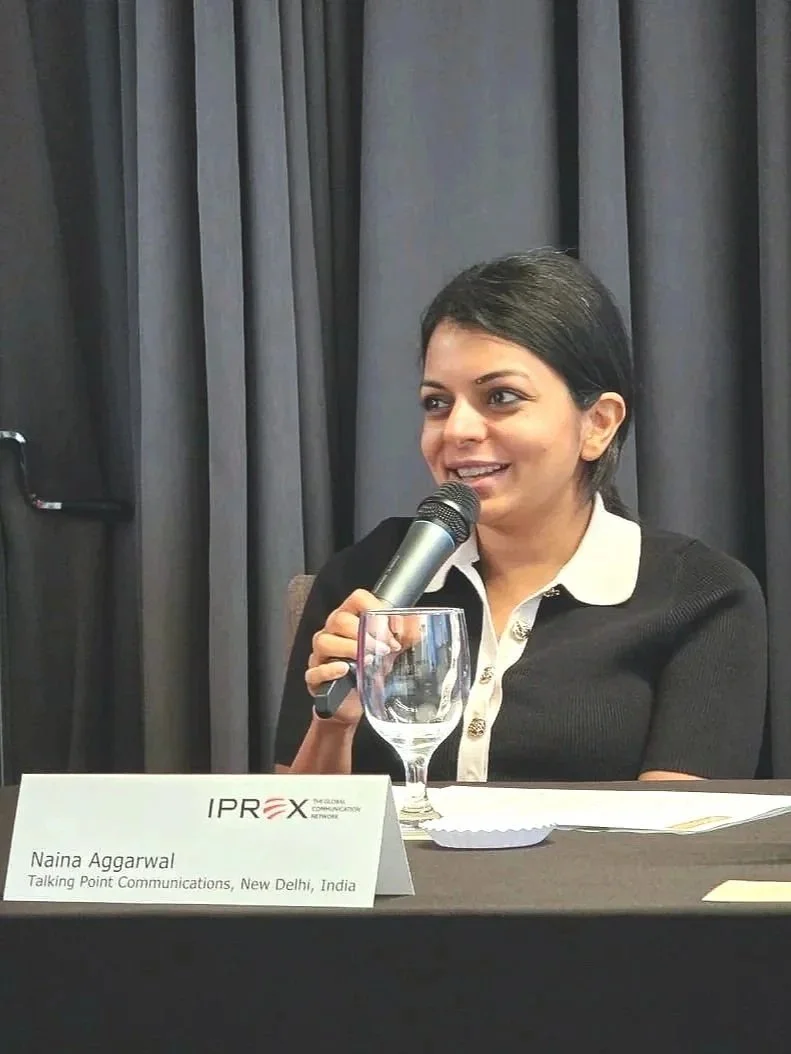
“Media training today needs to prepare spokespeople for how their words will travel once they enter the public domain. In a diverse and fast-moving market like India, an answer can move across traditional media, social platforms and multiple language ecosystems, where it can be clipped, reframed or amplified within seconds. In an age of AI-generated content, clarity, authenticity and staying anchored in facts are essential to maintaining credibility.”

“Paid media rents attention. Owned media asserts expertise. Earned media transfers belief. In a world saturated with synthetic claims, that transfer of belief has become the most valuable and competitive advantage a brand can hold,” said Merritt Woodward, Partner, Walt & Company. “The brands that capitalize on this shift will be those that approach earned media strategically and globally—building credible narratives that travel across markets, influence how they are discovered, and strengthen their authority wherever audiences are searching for answers.”
Another recurring theme from trainers in the network: the rise of AI is not a reason to over‑script executives. If anything, there is a premium on distinctive, human answers that reflect real experience and judgement. AI can help rehearse; it cannot replace the credibility that comes from lived expertise.
A word on cultural differences
Media training has never been one‑size‑fits‑all, and AI has not changed that. What works in a U.S. press conference — direct confrontation, rapid back‑and‑forth, clear soundbites — will not land the same way in Tokyo, Riyadh or Lagos.
Effective global programmes:
Tailor tone, non‑verbal communication and examples to local norms about hierarchy, face‑saving and public disagreement
Prepare spokespeople for different expectations around disclosure and apology in each market
Use local trainers or partner agencies who understand both the global narrative and the media culture on the ground
The underlying skills — clarity, honesty, empathy and control — stay consistent. The way they show up needs to be calibrated market by market.

Turning insight into action
For PR professionals and communications leaders, the message is clear: the fundamentals of media training still apply, but the stakes and scenarios have changed. Spokespeople now operate in an environment where AI‑generated content can distort context, journalist workloads compress nuance, and social feeds decide which 20 seconds of a 20‑minute conversation the world remembers.
IPREX agencies are helping clients redesign media training for this reality — combining classic interview skills with AI‑aware preparation, multi‑platform rehearsal and culturally tailored coaching across more than 40 countries.
As AI increasingly shapes how narratives are created, circulated and discovered, communications teams also need to consider who is shaping the story around their organisation. For further perspective on maintaining narrative control in an AI-driven world, read Operate’s article, Who Controls Your Narrative in an AI-Driven World?
If you are reviewing your media support for the year ahead, you can:
Talk to an IPREX partner about bespoke media training for your leadership team
Explore IPREX resources and webinars on media handling and crisis communications
Or contact the network to build a programme that aligns with your global communications strategy and local market needs
Why this matters
Three years ago, it made sense to explain what an LLM was. Today, the more relevant question is how agencies build lasting capability around AI in a way that is thoughtful, measurable and commercially meaningful. That is a much more sophisticated conversation, and it says something important about how quickly this industry has evolved.
That is why I find this work so compelling. It reflects where agencies really are now: well into adoption, but ready for something more structured, more strategic and more durable. The agencies that stand out over the next few years will not simply be the ones using AI most often. They will be the ones that understand their capability most clearly and build on it most intentionally.
Over time, the agencies that stand out will be the ones using AI to systematically orchestrate narratives across earned, owned, shared and paid channels – with GEO as one important new lens – so that their expertise is visible wherever clients look, including in AI-powered search and LLM answers.
Connect with IPREX to prepare your spokespeople to communicate with clarity, credibility and confidence wherever the conversation moves next.