


By Alexandra Mayhew
Everyone in your agency is using AI. Almost no one has had a structured way to see what that really adds up to. Recent IPREX work shows AI adoption is now effectively universal across independent communications and marketing agencies. Teams are using AI tools every day, staff confidence is high, and experimentation is happening across research, content, reporting and operations.
That is what makes this next phase so important. The question is no longer whether agencies are using AI. It is whether they can clearly see their own readiness, understand where they are strongest, and make smarter decisions about what comes next. That is the work now underway through the IPREX AI Taskforce and the agency readiness diagnostic it is building.
From explaining AI to building capability
I remember standing before the membership in Delhi in 2023, giving a presentation on AI, and one of my slides simply explained what large language models were. At the time, that felt like the right conversation. Three years later, the pace of change has been extraordinary. I have rarely seen this industry move so quickly from curiosity to capability.
That shift is exactly why this initiative matters. Agencies are not standing at the starting line anymore. They are already using AI in meaningful ways. The real opportunity now is to understand how deeply that capability runs across the business, how well it is supported, and how it can be developed more intentionally over time.

What agencies need now
The reality inside agencies today is energetic. Teams are testing tools, refining workflows, finding efficiencies, experimenting with insight generation and responding to a growing number of client questions about how AI is being used and where it adds value. For some agencies, this already includes AI‑driven search visibility work (GEO) as one of the ways AI shows up in their offer. Once AI becomes part of everyday work, agency leaders need more than anecdotes and isolated examples. They need a clearer instrument panel.
This is exactly where the diagnostic comes in. It is a structured survey and scoring framework that IPREX members can complete ahead of their regional conferences, generating a one‑page snapshot and deeper pillar insights for each agency.
It gives agency leaders a structured way to see how AI is showing up across the business, where momentum is strongest, where more formalisation would help, and what kind of development path makes sense from here. It is not about exposing weakness. It is about helping agencies make better strategic decisions while the market is moving quickly.

A global lens on how agencies are using AI
One of the most compelling things about this work is that the patterns are recognisable across markets. Whether the conversation is happening in Buenos Aires, Boston, London, Stockholm or Berlin, agencies are asking many of the same questions: how do we use AI well, how do we explain it clearly to clients, and how do we turn day‑to‑day experimentation into real capability?
The taskforce reflects that global reality. It brings together partner perspectives from North America, Latin America, the UK, Germany and the Nordics, creating a diagnostic shaped by different client environments, data realities and market expectations, but anchored in a shared understanding of what agency readiness now requires.

“AI will increasingly shape how agencies differentiate and articulate their value. Leaders should understand where AI can strengthen their agency’s distinctive capabilities and embed that into a clear, credible value proposition for clients”
“At Spotlight (Sweden) we have a vision to be the most curious AI agency in the local market. To fuel this, we have a mantra saying “never without AI and never with only AI”. This goes for every project and every process at our agency. ”


“The real question is no longer whether agencies are using AI, but whether they are building lasting capability around it with GEO already leading the way for many of us. ”
Seeing readiness across five pillars
What makes this work especially valuable is that it moves beyond tool usage. Across IPREX’s broader AI resources, there is already useful survey insight into how teams are adopting AI and how they feel about it. This diagnostic goes further by helping agencies assess themselves in a more strategic, multidimensional way.
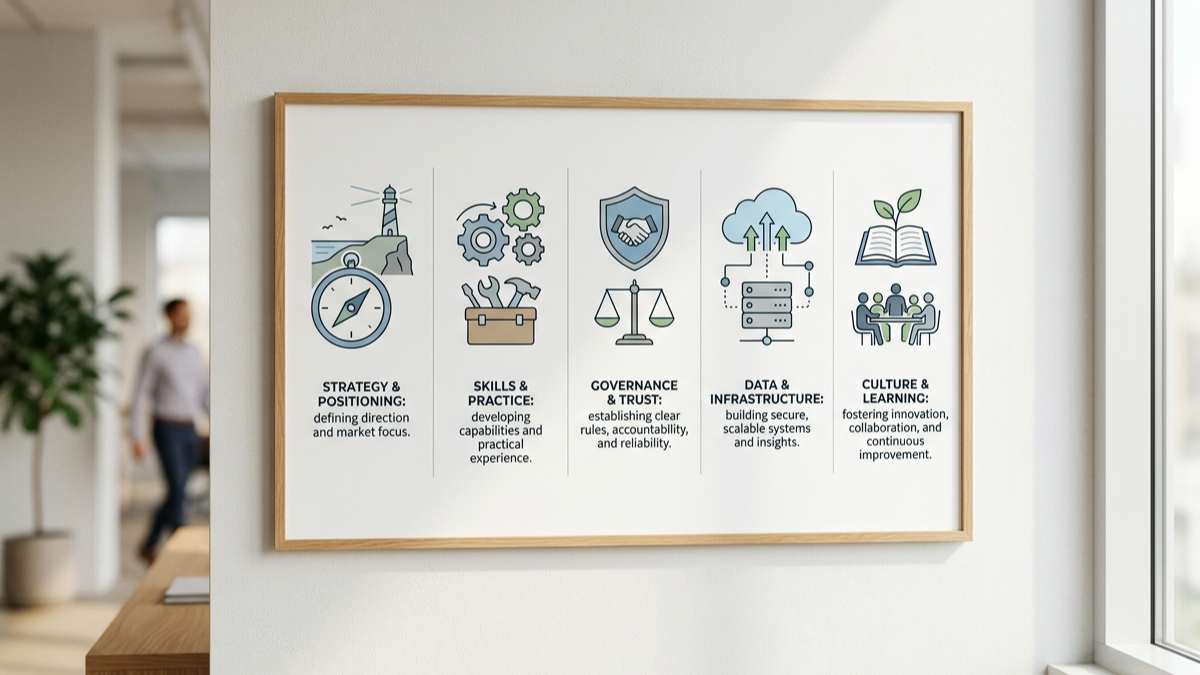
It does that through five pillars:
Strategy and positioning – how clearly AI is reflected in the agency’s value proposition, offer and future direction.
Skills and practice – how confidently and consistently teams are using AI to improve the work.
Governance and trust – how policies, disclosure and responsible use are handled.
Data and infrastructure – how ready systems, workflows and information are for AI‑enabled work.
Culture and learning – how AI is being embedded into behaviours, leadership discussions and ongoing development.
Taken together, these pillars offer a fuller picture of readiness. They shift the conversation from “Which tools are we trying?” to “What kind of AI capability are we actually building?” That is a much more useful question for agencies thinking about growth, positioning and long‑term value.
The pillars also help leaders distinguish pockets of experimentation from genuine organisational change – moving the focus from AI tools on individual desktops to AI embedded in strategy, culture and client value.
“Looking across all five pillars changes the conversation from just ‘using AI’ to understanding when, where, how, and why you’re using AI. This enables agencies to embed AI into actions to move from tactical to strategic as needed.”

Designed by agencies, informed by external insight
Another strength of the diagnostic is the way it has been built. It has been shaped by agency leaders who are already navigating AI in live client environments, while also drawing on external AI and research perspectives that help challenge assumptions and broaden the lens.
That combination matters. Agencies do not need a generic maturity model built for some other category of business. They need something grounded in the realities of communications and marketing work, but informed by a wider view of how AI is affecting trust, reputation and expectations in the market.

“Our AI diagnostic was built by agency people, for agency people. The results don’t just tell you where you stand — they tell you where you stand in this industry, against the realities of this work. A generic model can measure adoption, but it can’t tell you what adoption should look like in a business like ours. ”
From diagnostic to development
The diagnostic is not intended to sit on a shelf. It is the starting point for a broader program of work. The findings will be explored more deeply at regional conferences, where agencies can compare perspectives, discuss what they are seeing in their own markets and begin translating results into action.
From there, the next phase will build into 2027 through training, webinars and peer learning designed to help agencies strengthen capability across the five pillars. And because the diagnostic can be taken again, agencies will have a way to measure progress over time rather than relying on instinct alone.
Why this matters
Three years ago, it made sense to explain what an LLM was. Today, the more relevant question is how agencies build lasting capability around AI in a way that is thoughtful, measurable and commercially meaningful. That is a much more sophisticated conversation, and it says something important about how quickly this industry has evolved.
That is why I find this work so compelling. It reflects where agencies really are now: well into adoption, but ready for something more structured, more strategic and more durable. The agencies that stand out over the next few years will not simply be the ones using AI most often. They will be the ones that understand their capability most clearly and build on it most intentionally.
Over time, the agencies that stand out will be the ones using AI to systematically orchestrate narratives across earned, owned, shared and paid channels – with GEO as one important new lens – so that their expertise is visible wherever clients look, including in AI-powered search and LLM answers.
How to engage
For IPREX members, the next step is simple: watch for the diagnostic and come ready to engage with it at your regional conference. For prospective partners and the wider industry, this work signals the kind of practical, forward‑looking AI capability building now taking shape across the network. Visit iprex.com to learn more about membership and collaboration opportunities.