Article | By Alexandra Mayhew
Alexandra Mayhew is Executive Director of IPREX, a global network of more than 1,100 independent communications professionals across 100+ markets. She teaches a Master of Strategic Global Corporate Communication at the University of Colorado Boulder and designed IPREX's inaugural virtual Leadership Development Conference.
Most leadership training makes a quiet assumption: that the fundamentals of how to lead, communicate, and build a team are more or less universal. Apply the right frameworks, develop your emotional intelligence, run a clean meeting, and you will be effective wherever you go.
That assumption does not hold up.

What Is Cultural Intelligence?
Cultural intelligence is the ability to function effectively across different cultural contexts. It is not the same as cultural sensitivity, though that matters too. It is the active capacity to recognise how cultural differences shape the way people receive authority, process feedback, interpret silence, and make decisions, and to adapt your leadership and communication accordingly.
Psychologists Christopher Earley and Soon Ang, who developed the concept in 2003, defined cultural intelligence as having four components: the motivation to engage with different cultures, knowledge of cultural norms and values, the awareness to recognise cultural cues in real time, and the behavioural flexibility to adjust how you act.
For communications professionals and agency leaders, all four matter. But the last two, awareness and adaptability, are where most people have the largest gaps.
Why Does Cultural Intelligence Matter for Agency Leaders?
The agencies that struggle most in global markets rarely have a strategy problem. They have a cultural intelligence problem. And because it is largely invisible, they often do not know it.
It shows up in predictable ways:
A message that worked in one market lands flat in another. Not because the strategy was wrong, but because what signals credibility, urgency, or trust differs by audience.
A high-performing team member struggles to lead a new group. Not because their skills have changed, but because their defaults around hierarchy, directness, or consensus do not translate.
A client relationship stalls despite strong work. Not because the output is poor, but because the communication style, cadence, or tone does not match what the client expects.
These are not edge cases. For any agency working across geographies, cultures, or even generational lines, they are routine leadership challenges.

What Frameworks Help Build Cultural Intelligence?
Hofstede's Cultural Dimensions Model
One of the most widely used frameworks is Geert Hofstede's cultural dimensions model, which maps cultures along six axes:
Power distance: How much do people accept hierarchical authority? Do teams expect to be directed or consulted?
Individualism vs. collectivism: Does the culture prioritise individual achievement or group cohesion?
Uncertainty avoidance: How comfortable are people with ambiguity? Does the culture prefer clear rules or flexibility?
Long-term vs. short-term orientation: Is the focus on building relationships over time or delivering results quickly?
Masculinity vs. femininity: Does the culture value competition and assertiveness, or cooperation and quality of life?
Indulgence vs. restraint: How much does the culture allow for the gratification of basic human desires?
None of these are value judgments. They are observations about norms. For a communicator, they are practical tools for anticipating how your message will land before you send it.
The Cultural Intelligence Scale (CQS)
Developed from Earley and Ang's original research, the Cultural Intelligence Scale is a validated self-assessment that measures your CQ across the four dimensions: motivational, cognitive, metacognitive, and behavioural. It is a useful starting point for leaders who want to understand where their gaps actually are.
How Do You Build Cultural Intelligence in Practice?
Cultural intelligence is not built through a one-hour workshop. It develops through structured exposure, reflection, and deliberate practice. The most effective approaches include:
Start with self-awareness. Before you can understand how culture shapes others, you need to understand how it shapes you. What are your defaults around hierarchy? How do you handle conflict? What do you read as engagement or disengagement? Your own cultural background has shaped all of it, and most of it is invisible until you examine it.
Work through real examples. Abstract frameworks only go so far. Learning accelerates when you apply them to actual situations: a client relationship that stalled, a team dynamic that did not make sense, a campaign that did not connect. What happened, and what does that reveal about what you were bringing to the situation?
Build in structured reflection. Cultural intelligence grows when you pause long enough to interrogate your own assumptions. What did you expect? What happened instead? What would you do differently?
Learn directly from practitioners. There is no substitute for hearing from agency leaders who have navigated cross-cultural environments in practice, made real mistakes, and developed real judgment. That kind of peer learning is where concepts become applicable skill.
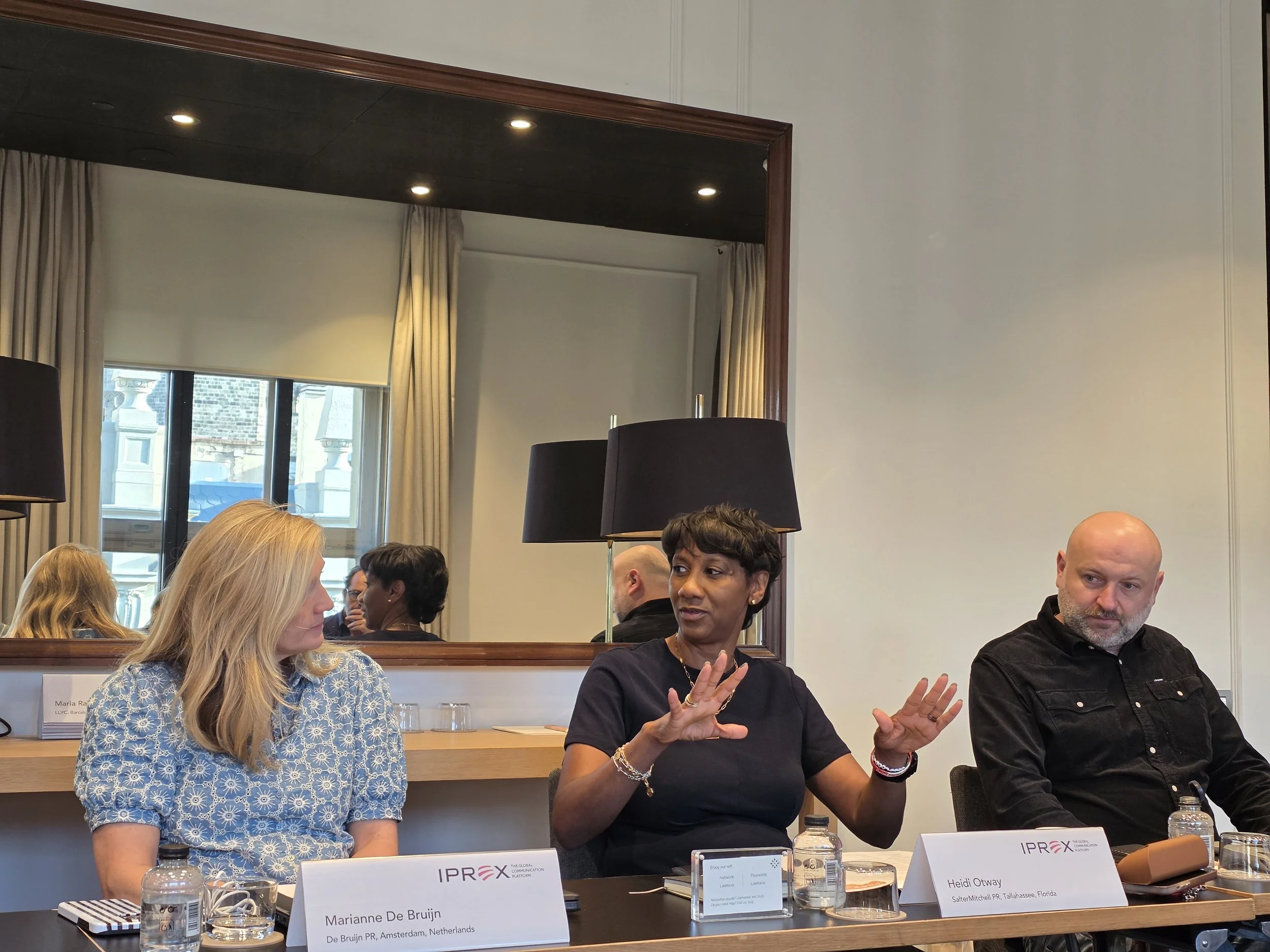
What Does Cultural Intelligence Look Like in a Global Communications Agency?
For a communications agency, cultural intelligence shapes decisions at every level:
Client strategy: A message that builds trust in North America may need more than translation to work in Latin America or Southeast Asia. The framing, the messenger, the channel, the timing, all may need to shift.
Team leadership: Leaders who default to their own cultural norms around directness, feedback, or decision-making will create friction with team members who operate differently, without either party being able to name what is happening.
New business: The way you pitch, follow up, and build a relationship with a prospective client is read through a cultural lens. What signals confidence in one context can signal arrogance in another.
Crisis communication: Different markets have very different expectations around transparency, speed of response, and who the appropriate spokesperson is. A one-size-fits-all crisis plan will fail somewhere.
What IPREX Learned Running Its First Leadership Development Conference on Cultural Intelligence
In 2026, IPREX launched its inaugural Leadership Development Conference (ILDC), the first structured leadership program in the independent agency space built exclusively around cultural intelligence.
The five-day virtual program brought together emerging agency leaders from across the Americas and Europe, with expert panellists representing agencies in North America, Latin America, and Europe. Each day focused on a distinct dimension: self-awareness as the foundation of leadership, cultural awareness in communication, leading teams across differences, and applying cultural insight to strategic decisions.
Participants reported increased confidence applying cultural intelligence frameworks — including Hofstede’s model and emotional intelligence — in their day-to-day client and team work, one of the core goals the program was designed to achieve. Many said they would recommend ILDC to other emerging leaders in the IPREX network. Participants rated the program 8.8 out of 10 for overall satisfaction, and 94% said they were likely to recommend ILDC to other emerging leaders in the IPREX network.
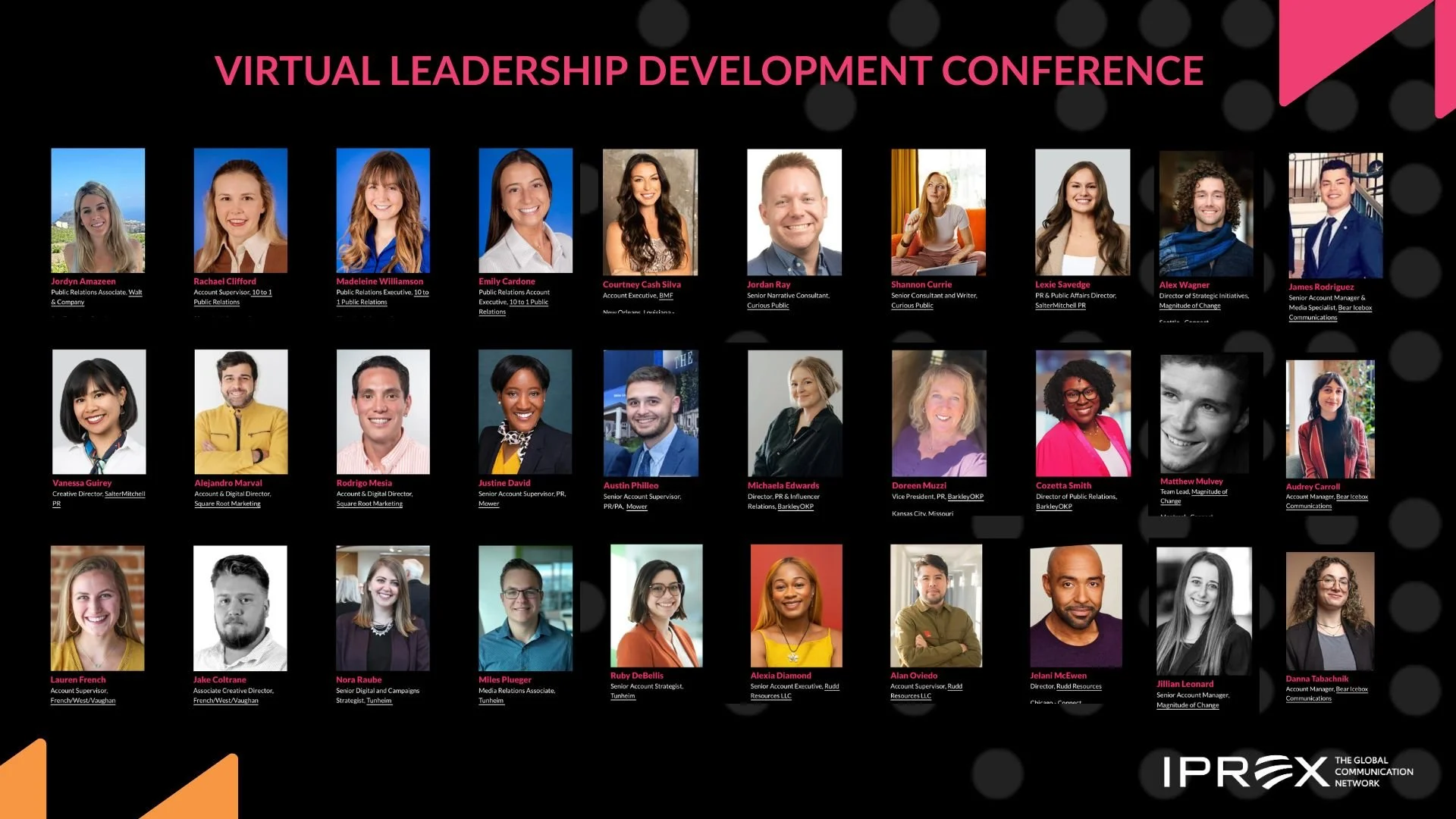
2026 ILDC Cohort
Key Takeaways: Cultural Intelligence for Communications Leaders
Cultural intelligence is a learnable, measurable skill, not a personality trait.
It shapes how your messages land, how your teams function, and how your strategies perform across different markets.
The Hofstede model and the Cultural Intelligence Scale (CQS) are two of the most practical frameworks for building it.
Building it requires more than awareness. It requires structured reflection, peer learning, and deliberate practice.
For independent agencies, it is becoming a core leadership competency, not an optional one.
About IPREX
IPREX is a global network of independent communications and marketing agencies with more than 1,100 professionals in over 100 markets. The network supports independent agencies through shared expertise, leadership development programs, and global collaboration.
The ILDC is available exclusively to IPREX member agencies. To learn about the next cohort, contact us.
