

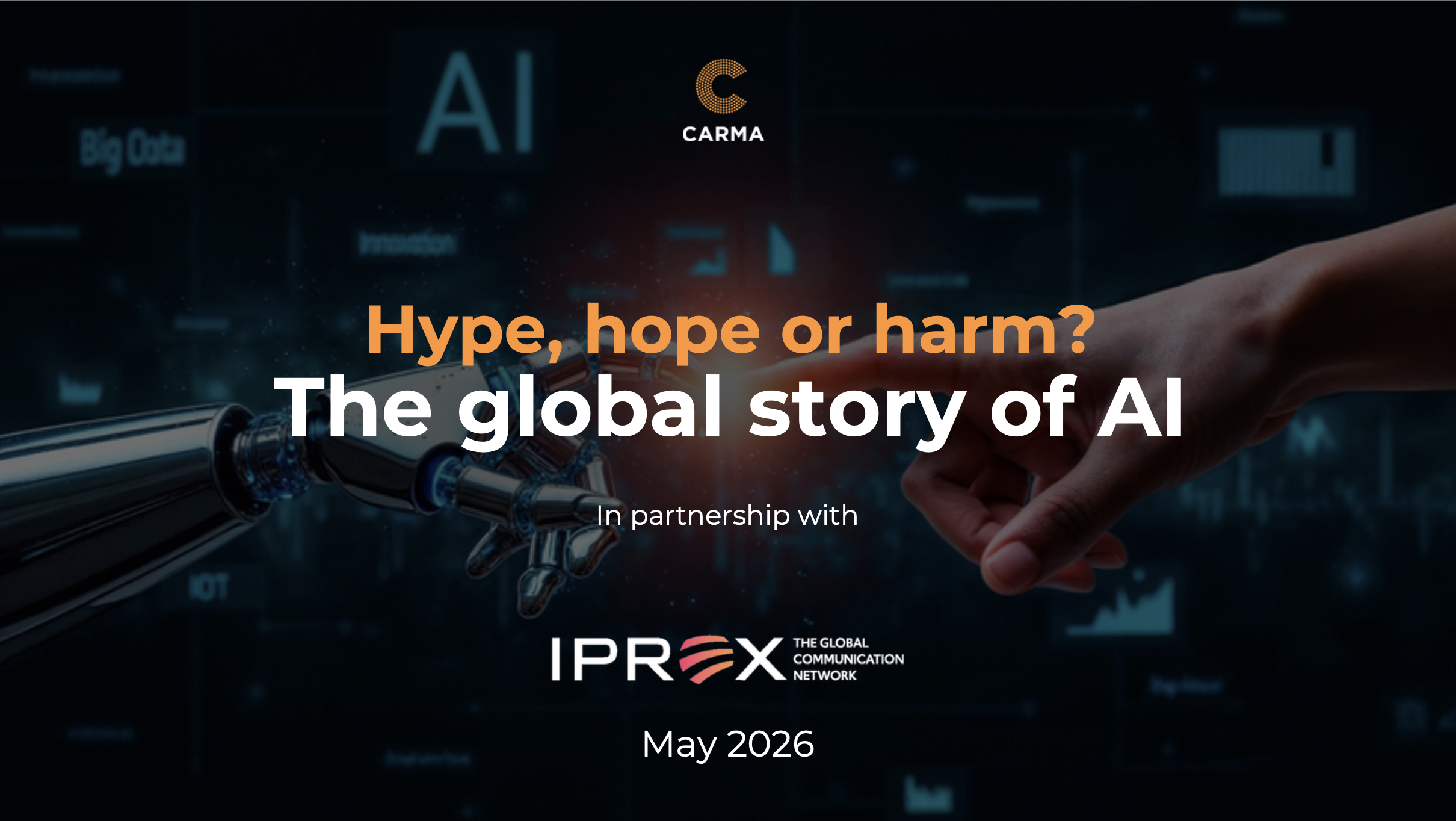
CARMA and IPREX Global AI Perception Study - Hype, hope or harm? The global story of AI report cover featuring a hand touching an illuminated AI interface
AI adoption among organisations is widespread, but governance and execution remain uneven
High-growth markets such as India and Brazil show the strongest optimism toward AI, while Western Europe, Canada and Japan form an “AI-anxious” cluster where concern outweighs excitement
Singapore, 26 May 2026 – CARMA and IPREX, the world’s leading global communications networks, have released a new study examining how artificial intelligence is being adopted, governed and understood across global markets. The research by the media intelligence company found that communications readiness and organisational strategy are struggling to keep pace with the rapid adoption of AI.
The report, Hype, hope or harm? The global story of AI, combines media analysis, public opinion research and practitioner insight to examine how AI narratives are evolving globally and where gaps are emerging between public expectations, media coverage and organisational readiness.
The study analysed 12,000 articles from 500 tier-one media outlets across 37 markets, alongside public opinion research covering 6,300 respondents in 19 countries and qualitative insights from 25 communications practitioners across 14 markets.
"Our research showed that the media narrative about AI's growth and the public narrative differed sharply. The media leaned into the technology's potential, while audiences anchored on cybercrime, misinformation, and who's held accountable when things go wrong. That gap is a trust deficit, which can compound. Communicators need to be able to measure the gap in order to work on their strategy," said Divika Jethmal, Head of Marketing at CARMA.
The findings arrive at a pivotal moment for communications professionals. According to the study's practitioner insights, AI adoption among clients is already widespread but execution is uneven.
Organisations are moving quickly to integrate AI into their workflows, often without fully developed structures, internal capability, or governance frameworks to match. As a result, there is a visible gap between how quickly AI is being adopted and how effectively it is being used.
“Artificial intelligence is reshaping how organisations communicate, engage stakeholders and manage reputation across markets. What this study makes clear is that while adoption is accelerating globally, confidence and trust are developing unevenly. Communicators are increasingly being asked to bridge the gap between innovation and accountability — helping organisations explain not only what AI can do, but how it is being governed responsibly. As a global network working across diverse markets, IPREX sees first-hand how cultural context, public sentiment and local expectations are shaping the future of AI communications,” said Ann-Marie O’Sullivan, Global President, IPREX.
However the gap is not merely operational. Most organisations have yet to define how to communicate their AI strategy externally, leaving messaging reactive and inconsistent.
Key findings from the study include:
The dominant risk narrative is loss of control. Media coverage increasingly frames AI systems operating without meaningful human oversight as the most severe risk. Yet the public concern centres on cybercrime, misinformation, and deepfakes, a gap that communicators are only beginning to address.
Optimism leads, but is fragile. Positive sentiment accounts for 57% of global AI media coverage, but peaks are event-driven tied to model launches, investment announcements, and major conferences.
CEOs shape the story but narrowly. AI company executives account for 43% of top commentator coverage and consistently drive positive sentiment. However, over-reliance on executive voices creates fragility; independent experts and technical leaders remain underused as credibility anchors.
Trust is earned differently by media and audiences. While media emphasises accuracy and reliability as the primary trust drivers, audiences rank safety and misuse prevention first and place greater weight on transparency than coverage suggests.
Global emotion is not uniform. High-growth markets including India, China, Saudi Arabia, and Brazil show the highest excitement levels. Western Europe, Canada, Japan, Italy, and France sit in an "AI-anxious" cluster where fear outpaces excitement.
The full report is available at https://www.iprex.com/globalstoryofai
Ends
For media enquiries, please contact:
About CARMA
CARMA is a global monitoring and research company. We help companies analyse earned media intelligence, social listening, and public opinion. We turn data into strategic insight through a combination of our proprietary technology and expert consulting. Discover CARMA’s suite of solutions, our analysts, and the global clients we work with. www.carma.com
As seen in: https://campaignme.com/the-ai-trust-gap-is-a-communications-problem-and-it-is-widening/
About IPREX
IPREX is a global network of independent communications and marketing agencies with more than 1,100 professionals in over 100 markets. Its partners are led by senior practitioners who combine deep local insight with global reach to support clients across geographies and sectors. The network strengthens independent agencies through shared expertise, leadership development and collaboration that supports new business, empowers agency leaders and helps partners run stronger operations.