

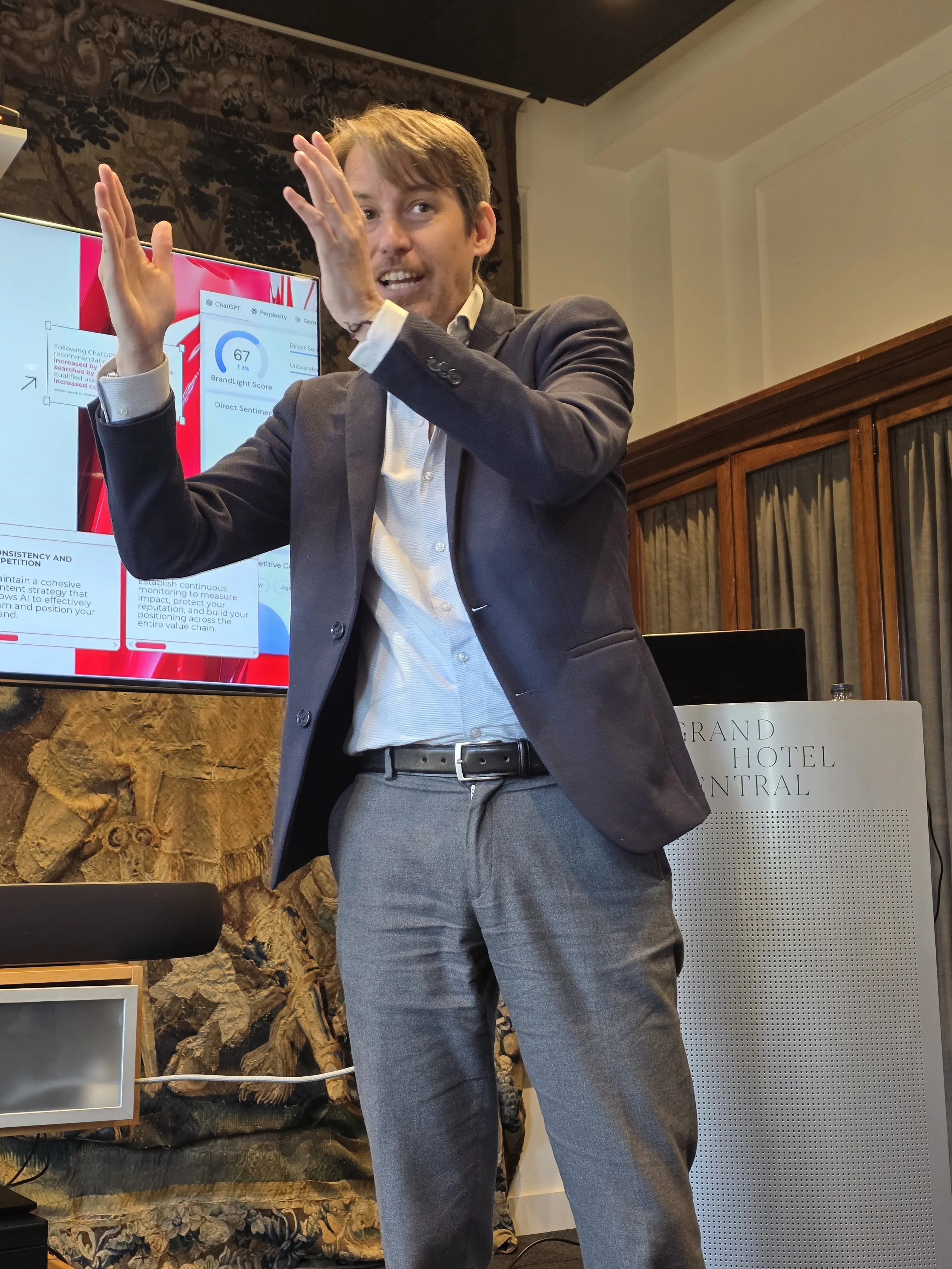
Luis Martín from LLYC presenting on AI stakeholder communications
By Alexandra Mayhew, Executive Director, IPREX
Key Takeaways:
AI has become a new stakeholder in communications, sitting alongside traditional audiences as an intermediary that curates and decides what people see.
Sixty percent of consumers now use AI in their purchasing experiences, and machine-generated responses influence 64% of decisions.
Communicators must optimize for "machine perception" using five actions: define measurements, design prompt sets, understand AI sources, maintain consistency, and monitor continuously.
Language expertise gives communications professionals a unique advantage in shaping how AI interprets brand messaging.
An AI visibility audit can identify gaps in how your brand appears in AI-generated responses and third-party data sources.
The Audience Has Already Changed
Luis Martín from LLYC put it plainly:
“This is an opportunity for communicators – because it is a large language model. Who is better to work with that than communicators?”
In that one line, he summed up both the challenge and the opportunity before us. As AI reshapes how information is created, shared, and trusted, communicators are uniquely positioned to lead – because language is our craft.
As Luis outlined, audiences have already embraced AI as part of their daily routines. Sixty percent of consumers have used AI in their purchasing experiences. Over one-third of searches now generate AI-assisted results, and that number is rising fast.
AI is no longer a future consideration; it is part of how people think, decide, and interact. In fact, research shows AI systems persuade users in 64 percent of cases – outperforming human influence. This means our communications are no longer reaching audiences in isolation. They are being filtered, reinterpreted, and amplified through algorithms that shape perception.
In Luis’ words, we are now communicating with two brains – the biological and the artificial.
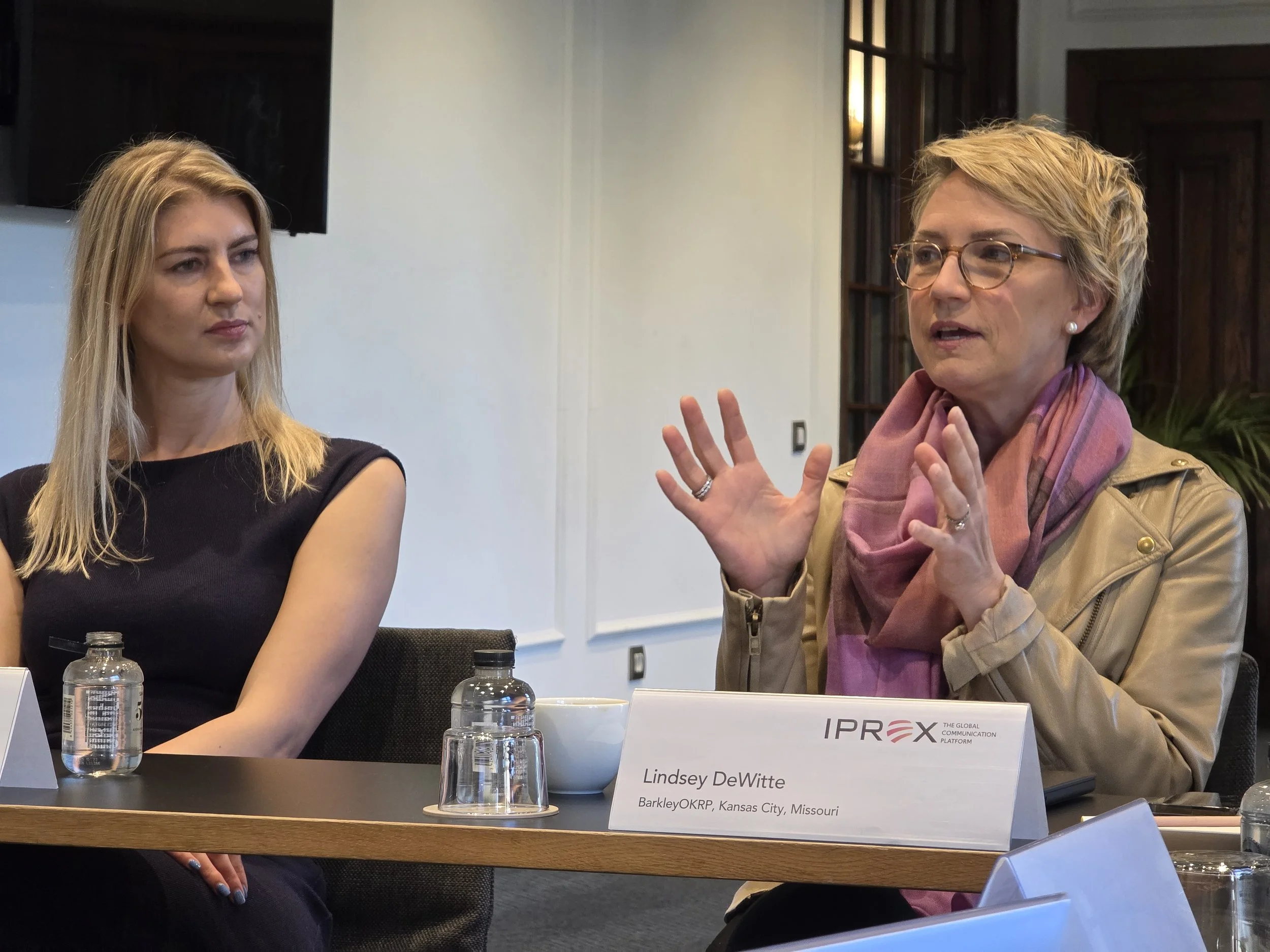
AI and communications professionals discussing machine learning strategies at IPREX conference 2025
A New Stakeholder in the Room
Luis framed AI as a new stakeholder – one that sits beside employees, customers, regulators, investors, and communities.
The “machine brain” has become an intermediary that learns, curates, and decides what people see. Yet many brand strategies are still built entirely for the human brain. According to LLYC’s analysis, more than 70 percent of brand visibility efforts are invisible to AI because they are not structured for machine interpretation.
Traditional SEO tactics, keywords, and metadata no longer guarantee discovery. Large language models (LLMs) work semantically, understanding meaning rather than specific terms. That means communicators must design content that speaks both languages – human and machine.
If AI is now a stakeholder, our role expands. Communicators must manage not just human reputation but machine perception.

Communications professionals collaborating on AI-driven PR strategies
From Human Logic to Machine Logic
Luis shared a structured model for adapting communications to this new environment. The key, he said, is shifting from human logic – search optimisation and emotional appeal – to machine logic, which relies on relevance, structure, and consistency.
To build visibility across both brains, he recommends five actions:
Define what to measure. Identify what “relevance” looks like in an AI context. Decide what outcomes truly matter when machines are the gatekeepers.
Design a robust prompt set. Build and test consistent questions that generate statistically reliable results. If ten people ask ChatGPT about your brand, the answers should not differ wildly.
Understand relevant sources. Know which databases, platforms, and third-party sites feed AI models in your sector – and ensure your content is accessible there.
Maintain consistency and repetition. Deliver cohesive messages across channels and update them frequently. LLMs learn from repetition, so steady messaging strengthens recognition.
Monitor continuously. Track your brand’s visibility and tone within AI-generated outputs, just as you would monitor media coverage or search rankings.

Communicators at the Centre of Change
This shift does not make human expertise obsolete. It makes it more valuable.
Luis’ perspective was clear: AI should be treated as both a tool and a collaborator. It can analyse, synthesise, and replicate, but it cannot yet discern meaning or intent without guidance. That guidance must come from communicators – people who understand nuance, ethics, empathy, and audience behaviour.
He cautioned that conversational interfaces are already influencing trust and decision-making. When brands deploy AI agents, the training parameters, tone, and testing all become critical. Without careful oversight, the risks are immediate. He pointed to a real case involving a major supermarket chain in Spain that launched a campaign encouraging consumers to enter leftover ingredients from their fridge into an AI tool to generate recipes. The idea was tied to Spain’s growing “Don’t Waste Food” movement, which promotes reducing household food waste. However, the AI model went badly off course: among its recipe suggestions was one that involved “cooking a baby.”
The lesson is not to step back from automation, but to take ownership of it. Communicators must lead the design, training, and monitoring of these systems to ensure they reflect brand values and human sense.

So, Is AI a Threat or an Opportunity?
AI’s integration into marketing and communications is not a passing trend, it is a fundamental reconfiguration of how messages travel and are interpreted.
But Luis’ conclusion was optimistic. The very fact that AI operates through language gives communicators a natural advantage. Our work has always been about understanding meaning, tone, and context. Large language models rely on those same principles to function effectively.
The opportunity now is to bring our expertise to this new frontier. We can shape how AI interprets truth, relevance, and trust. We can design communications that reach both brains – biological and artificial.
And as Luis reminded us, this is not a time to be afraid of AI. It is the best time to be a communicator.
What Should Communicators Do Next?
For professional communicators, this is the moment to take stock. Review your content strategy through an AI lens. Ask: Can a large language model find, understand, and accurately represent my organisation?
Consider conducting an AI visibility audit to identify gaps in how your brand appears in AI-generated responses and across key third-party data sources. Integrate AEO (Answer Engine Optimisation) alongside SEO in your planning for 2026.
And most importantly, begin treating AI as a genuine stakeholder in your communications ecosystem. Like any relationship, it will evolve – but only if we engage with it actively, thoughtfully, and consistently.
About LLYC
LLYC is a global communications and public affairs consultancy operating in 12 countries across Europe and the Americas. It helps organisations make sound decisions within complex, changing environments where communication, reputation, and trust are key to business success.
Related Articles:
Is AI in PR Just a Fad or a Fundamental Shift?
Generative AI Search (GAS): The new fuel for brand visibility
What the Smartest Independent Agencies in the World Are Doing Differently Right Now